News
For most people who decide to enter the realm of off-roading in Australia, this is a right-of-passage moment. You purchase the vehicle, and you want to head out and explore the tracks, and before you know it, you find yourself wishing that your stock clearance would do just a little bit more when faced with a rutted-out hill in the Victorian High Country or sandy stretches of K’gari.
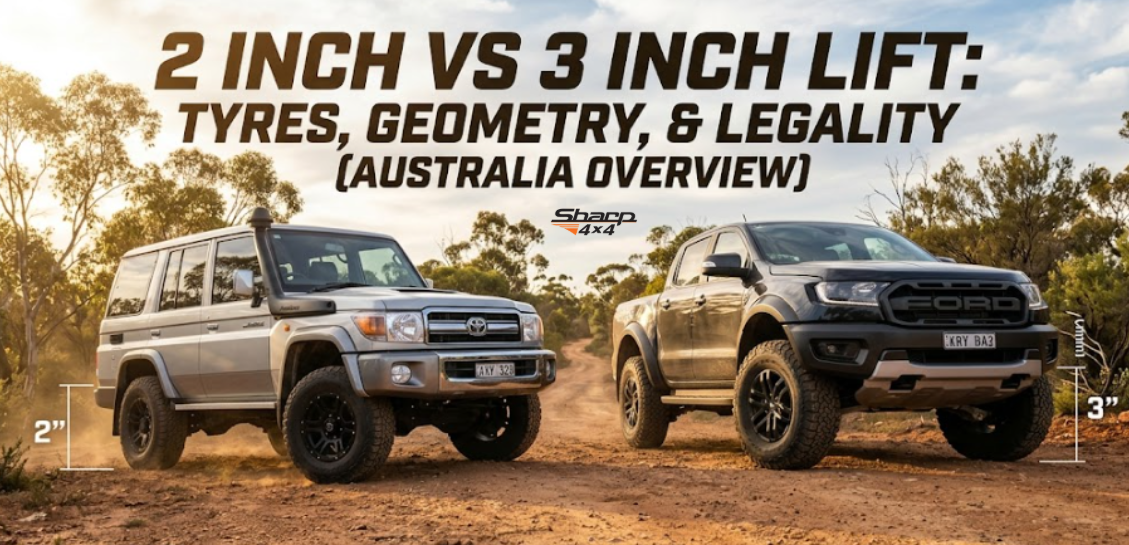
The inevitable dilemma that most off-road aficionados face then is one that has been debated time and time again: 2 inch vs 3 inch lift? Sure, it may just be an additional twenty-five millimetres, but there are a lot of issues to think about here, from engineering challenges to budgeting and not to mention keeping the Australian transport authorities happy. Our guide will help you make the right purchase for 4WD suspension lift kits.
Prior to discussing the height in question, it is important to know how suspension lift kits affect your car. First of all, a kit serves as a replacement of the springs and shock absorbers that come as the stock equipment and is used to add clearance between the chassis and the road surface. That gives you better approach, departure, and ramp-over angles, thus preventing the risk of costly panel damage.
Nevertheless, there is more to consider here. As for the 3 inch lift vs 2 inch setup, keep in mind that you change not only the height but also the balance point of your vehicle, namely, the center of gravity and the angles at which it operates. A good kit will suit the weight of your car perfectly, considering the added weight of bull bars, winches, and even rear canopy installations.
The go-to choice for the bulk of Australia’s off-roaders is the lift kit with an extra 50mm or 2 inches of ride height. There is good reason why it is the most common type of 4WD suspension lift kits in all of Australia.
A 2-inch lift provides an adequate increase in ground clearance without being too close to the physical restrictions of an independent front suspension (IFS). With a 2-inch lift, factory parts including brake lines, CV joints, and control arms should remain within normal operating limits.
It is ideal for weekend adventures but also for the weekdays when you need to drive to work. It is the ideal height, as it offers increased clearance while not compromising comfort to the point where you would feel as if you went through ten rounds of boxing after a lengthy highway drive.
Choosing to go for the lift that will take you to the three-inch lift level rather than the two-inch one means you are now venturing into new territories. That extra inch will mean a world of difference since things begin to get “technical.”
In addition to its beauty and extra space in extreme rock-crawling terrains, it comes with numerous mechanical concerns. The steep angles created in the CV boots tend to create problems such as damage.
Which makes it necessary to go for solutions like diff drops and adjustable panhard rods to ensure that the axles are centered and the brakes are not compromised. This means that the three-inch lift is more costly since there are accompanying costs that come with it.
When considering modifications to the 4×4 vehicle here, it is important not to overlook lift legality Australia. Australian legislation is known to be quite stringent and differs from one state to another, with the National Code of Practice (VSB14) being applicable for the majority of regions.
In general, 50mm suspension lifts are legal and do not require any engineering certification. Once the lift height gets coupled with changes in tyre diameter, it becomes possible to go beyond the maximum permissible “total lift,” which means obtaining a blue plate or engineering sign-off would be necessary.
Going for a 3-inch suspension lift would definitely bring you to the point where engineering certification will become a requirement to preserve the legality and validity of the insurance. An uninsured vehicle is not only going to be very costly but could end up resulting in a tragic insurance denial in the event of a collision.
The most common reason for needing a taller ride is that you need to run bigger rubber. In relation to lift kit tyre size, the common belief is that a higher lift means a bigger tyre can be fitted without trouble.
Although a higher lift does improve vertical clearance, “scrubbing” or rubbing typically occurs on either the body mounts or the inner guards if the car is steered to the full lock position.
Two inches of lift will provide plenty of space for 31-inch or 32-inch tyres on many dual-cab utes, while offsetting the wheels correctly can allow for 33-inch tyres on many of them.
Going further and lifting 3 inches will give you enough room for those 33-inch or even 35-inch tyres but not solve your geometry problems concerning the wheel arch. One thing to keep in mind is that with bigger tyres comes new gearing, and your speedo will be inaccurate and your engine will need to work harder.
It may surprise you, but vibration could be considered the hidden nemesis of both sides of the 2 inch vs 3 inch lift debate. Your drivetrain system operates with specific angles in mind. Lifting the body means altering those angles of the tailshaft and the CV joints.
For the most part, two inches will not affect those too much. The problem begins when installing three inches, which leads to something called driveline shudder, specifically during acceleration.
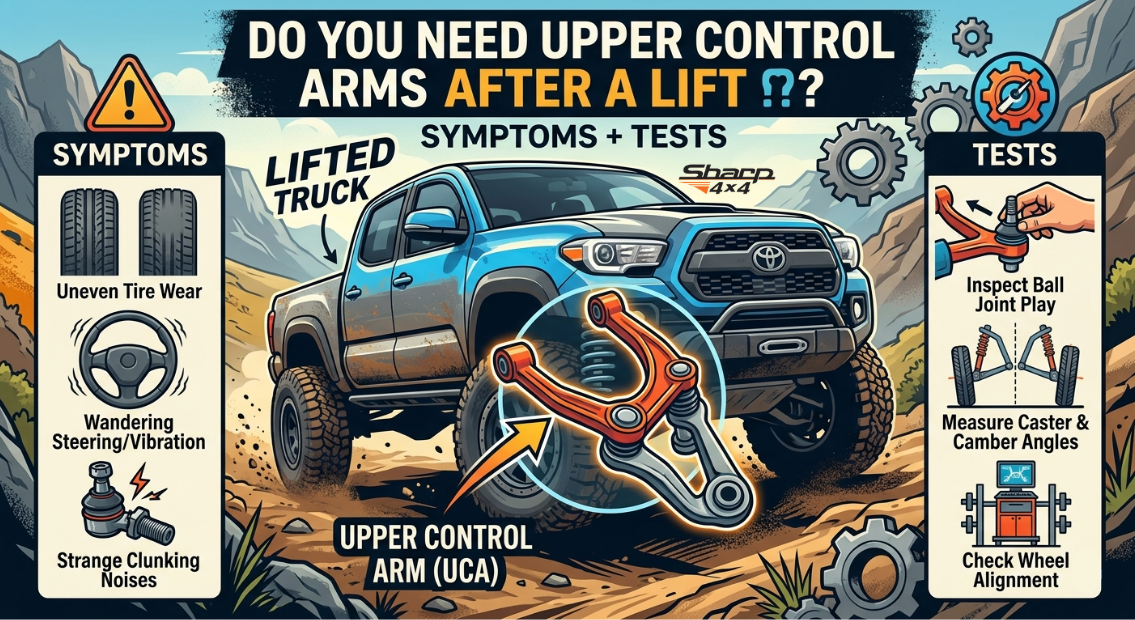
To counter this, one needs to spend more on correcting the casting or purchasing new, more angled upper control arms to get back in line with geometry. In other words, without correction, your four-by-four will wander down the road like it does not know where to go. Expect to replace tyres every couple of months because of uneven wear.
For those who have to haul a lot of stuff, like a fully loaded canopy or an off-roader trailer, the discussion invariably turns to engineered GVM upgrades. As a rule, the GVM upgrade includes a suspension lift in its package.
It should be remembered that a GVM upgrade is a legal operation that allows you to increase the loading capabilities of your car, and these are always capped at 2 inches in height. This is due to stability.
Car engineers are very reluctant to sign off on increasing the load of vehicles with high centres of gravity. If you want to stay legal but transport a huge amount of equipment around Australia in one go, then you probably need to engineer a 2-inch lift and get your GVM certified.
Having a lifted four-wheel drive is a bigger responsibility compared to a regular car as far as its maintenance is concerned. Regardless of whether you have opted for a 2 inch vs 3 inch lift, there is a considerable increase in the amount of stress that your bushings, ball joints, and shocks experience.
If the 4WD suspension lift kits you have chosen are 3 inches high, then you can imagine how severe the stress becomes. It is important that you keep checking the condition of your CV boots as they crack due to the increased angle. Additionally, suspension bolts should be checked for tension after every major off-road trip.
The decision will be greatly affected by the type of rig you own, whether it is a live-axle vehicle or an IFS (independent front suspension) vehicle. A classic example of this would be the 70 Series Land Cruiser or the old-style Nissan Patrols.
Such rigs handle the 3-inch lift much more effectively than a new Hilux, Ranger, or D-Max. This is due to the fact that there are no CV joints present in live axles, and it becomes much easier to correct geometry-wise.
If you are steering a modern dual-cab Ute, the 3 inch lift vs 2 inch decision becomes much more critical. Putting a 3-inch lift onto an IFS vehicle is risky enough, especially without dropping the diff, as you may break something in the middle of nowhere with no assistance available.
The budgeting process for the purchase of a lift kit does not only comprise the price of the springs and shock absorbers. The installation of a lift kit measuring 2 inches is inexpensive and not complicated at all.
However, the change from a 2- to a 3-inch kit results in doubling the entire cost of the operation. It is essential to consider the costs of the adjustable parts, the engineer’s statement if necessary, and the extra fuel usage caused by the additional height and bulky tires.
In addition, a “mildly” customized 4×4 vehicle with a 2-inch lift is usually sold at a higher price than a “heavily” customized one due to fears concerning its mechanical health condition.
Now let’s face why 3 inches really rocks. It provides a rugged look that screams attitude. But if you were driving in the Outback of Australia, you would have to be kidding yourself if style were more important than reliability.
Most of the legendary Australian routes, such as the Oodnadatta Track or the Canning Stock Route, require much more stamina than sheer ground clearance. In the long run, a properly engineered 2-inch system using good-quality shocks will win out over a junky 3-inch lift any day of the week.
When it comes to towing heavy trailers or caravans, there is no doubt that the choice between a 2 inch vs 3 inch lift would have some serious ramifications for your safety. The higher lift would mean the trailer is exerting greater leverage over the vehicle, leading to the “tail wagging the dog” phenomenon or trailer sway.
The 2-inch lift would be much better when it comes to towing purposes because it would mean that the center of gravity would be lowered, making the vehicle more stable. Furthermore, you would have to think about how high your tow hitch will have to be with the 3-inch lift.
A common misconception among newcomers in the car hub Australia is that adding lift height is the only option for navigating tough terrains. However, driver ability and tyre pressures account for more success than additional inches of wheel travel in off-roading.
Two inches of lift height give you sufficient ground clearance for at least 95% of trails found in Australia. The savings from selecting the shorter lift can be put to good use on a front locker, a strong winch system, or more efficient communication equipment. Avoid focusing solely on lift height when evaluating your 4WD’s capabilities.
Overall, the 2-inch lift is the sensible, safe, and legal solution for most of the 4WD drivers from Australia. This lift will give you better clearance, fit some decent tyres, and keep you from breaking any laws. In turn, the 3-inch lift is meant for the devoted hobbyists who can deal with all the maintenance work and difficulties that come with such a lift.
Therefore, think twice before making such an important decision and try to evaluate how much you need your vehicle and what you plan to do with it. If your vehicle is both your ride and a means of taking your family out on the road, choose a 2-inch lift.
The legitimacy of the 3-inch lift all boils down to what applies in your state and how high you can raise your car. In most areas of Australia, any lift beyond 50 millimeters or two inches is mandated to undergo engineering inspection or be granted a “blue plate.” The engineering inspection involves an engineer examining the lifted car to confirm that nothing on the car was affected negatively by the lift in terms of its braking, stability, and general safety. Otherwise, you risk heavy fines, a “canary,” and insurance invalidation.
Generally speaking, for contemporary Australian 4X4s with a 2-inch lift, 31-33-inch tyres would be ideal. Particularly, a 265/70R17 or 285/70R17 tyre (about 33 inches) would be one of the most common choices. Although 33-inch tyres could necessitate slight trimming or a special wheel offset to avoid scrubbing when the vehicle locks the steering wheel fully, it is a fantastic compromise that offers additional ground clearance while not sacrificing much in terms of fuel efficiency. Anything above 33 inches typically needs more than a 2-inch lift and extensive modification of wheel wells and gearing.
The installation of a lift kit does not automatically mean your entire car warranty will be invalidated. However, any part affected by the lift will no longer be covered under the manufacturer’s warranty. For instance, should there be a problem with the CV joint or if there is leakage in the steering rack after the installation of a 3-inch lift, the manufacturer can hold the lift responsible for the problems because it increases the stress and angle of those parts. That is why most people prefer a 2-inch lift.
A GVM upgrade is not a necessity for installing a lift, although these two services are usually performed simultaneously. When you plan to install additional items such as a steel bull bar, winch, roof rack, and drawers, there is an increased likelihood that your car will be close to the weight limit. An engineered GVM upgrade allows you to safely transport the extra load and provide you with a suspension lift that will accommodate the additional weight. If you are building a tourer and traveling with plenty of luggage, a GVM upgrade is a very good decision.
Whether you believe a 2-inch lift is the ideal height for your touring requirements or if you are ready to get stuck into the complexities involved in building a 3-inch monster, the experienced staff at Sharp 4×4 Australia is here to assist you with the 2 inch vs 3 inch lift dilemma.
Our business has specialized in manufacturing top-of-the-range 4WD suspension lift kits designed specifically to withstand the tough Australian terrain. Never compromise on your car’s safety and performance by making use of a generic, off-the-shelf product.
Our experts will advise you on all matters relating to lift legality Australia and will tailor-make the kit to suit your requirements.

Perth Showrooms In Cockburn & Myaree.

Product focused on safety, performance and quality.

Fast, Reliable Shipping Anywhere In Australia.

Relax We Warrant Everything We Sell.
Stay up to date with our latest news and deals.