News
You have made up your mind to purchase one of those performance-enhancing suspension lift kits, and your 4WD now looks brand new sitting in the driveway. Nothing beats having a little more ground clearance, coupled with an aggressive stance offered by a new lift kit.
Nevertheless, once you start driving around on tarmac or venture towards the corrugated roads of the outback, you will realise that your 4WD feels a bit flighty or wanders in the lane as if it had consumed one too many drinks at the local bar.
It is not uncommon for Australian off-road enthusiasts who consider themselves experts in their field to assume that upper control arms after lift installation only involve springs and shock absorbers.
In reality, modifying the height of your ride causes changes to the geometry of your front end. This is when the topic about whether a UCA needed after lift gains paramount importance in terms of both safety and tyre expenses.
Now, before discussing the symptoms, let’s first get familiar with the function of these suspension components. In a modern independent front suspension (IFS) system, which would be installed in practically all popular dual-cab pickup trucks such as the Hilux, Ranger, and Prado, the upper control arm serves as the upper pivot of your steering knuckle.
The lower arm functions with it, allowing your wheel to move vertically at the proper angle concerning the ground. Once you install your suspension lift kits, the lower control arm is pressed downward, forcing the top part of your steering knuckle towards your truck.
These changes make your alignment completely off from the optimal settings that were designed by the factory engineers after thousands of hours of tests. Although the factory arms work perfectly fine with standard-height vehicles, they are just not capable of functioning at the necessary angles of the lifted suspension.
However, the most important problem that you will encounter after a lift is a loss of positive caster. Imagine that the caster is the tilt of the wheels of a shopping trolley. When the axis of rotation is located ahead of the contact point, then the wheels are designed to move along a straight line.
For your 4WD car, caster correction is a technique to tilt the steering axis for maximum stability at high speed. However, if you lift your truck without modifying the arm assemblies, you lose positive caster. The steering becomes very light and vague, as if your wheels are floating.
Constant steering adjustments are necessary to keep within your lane on the highway. But if you have installed the aftermarket upper control arms after lift on your truck, you can create additional caster by relocating the ball joints.
Many guys assume that simply bringing the truck in for a standard wheel alignment after lift at the local tyre shop is going to fix the issue. However, despite any attempts made by the technician to do their best job, there is only a certain range of adjustment available through the factory adjustment cams on the lower control arms.
When the suspension system height has been lifted 50mm or more, these factory adjustment cams tend to “max out” and not be able to adjust the caster and camber angles back to within specifications on the alignment machine. The result is an alignment that is “compromised”.
The vehicle may drive well, but you will find that the tyres start to wear out quickly on the edge of the tread pattern because of scrubbing against the road surface. Real upper control arms after lift are needed for proper clearance and geometry adjustments to achieve a perfect alignment.
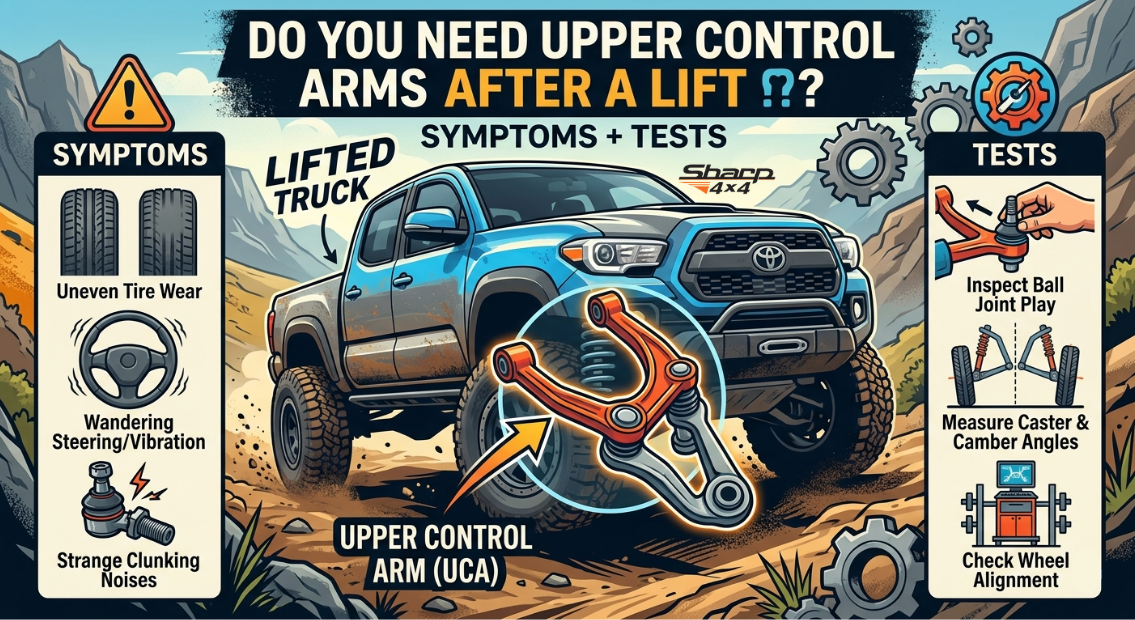
If you are unsure about whether your system can perform the required function well enough, there are some physical signs to watch out for. One of them is called “coil bucket contact”.
Due to the design of the factory arms, if you have a lifted strut, they can make contact with the coil spring itself or its housing in cases where the vehicle travels into a depression on the road. It is audible as a loud metallic click or clang.
Additionally, you may notice an uneven alignment of the wheels viewed from the front of the truck. This is referred to as “camber problems” and means that if the top of your tyres protrudes more than the bottom or vice versa, your factory arms cannot cope with it.
Lastly, another indication of whether you need replacement is if your car’s steering wheel does not return to the centre after making a turn. This is a textbook case of needing caster correction via aftermarket arms.
For people towing extremely heavy equipment and carrying lots of camping gear, you could end up with GVM-ready suspension packages for your car. These packages allow your vehicle to cope with increased load legally and safely.
This being the case, you should understand that there is a need for better suspension parts because most Gross Vehicle Mass (GVM) suspension components have very heavy springs, which end up being positioned higher than usual when loaded. With the increased GVM of your vehicle, you end up putting a lot of pressure on the bushing and joint areas.
The stock suspension arms have rubber bushings that end up being torn apart due to the increased articulation. Most upper control arms after lift will normally contain greasable ball joints and better bushings.
You do not always need an expert to determine whether your UCA needed after lift needs are a thing. In fact, one thing you can do at home will provide all the information you need about your vehicle.
First of all, raise the front of your car to the point where there is no contact between the wheels and the road. This is called “full droop” or the maximum amount of suspension drooping.
With the vehicle raised on jackstands, inspect the gap between your upper control arm and the coil spring. If they touch, or if the rubber cover on the ball joint looks stretched and compressed to its limits, then you have an issue that should be addressed before something more serious happens.
Contact between these two parts not only produces an unpleasant sound but also affects your ability to move on unpaved surfaces because, eventually, it causes the ball joint to break.
On the surface, it seems quite simple to avoid buying these upper control arms after lift parts by considering their cost, but most often, people end up paying much more because of them later on down the line.
For example, if you do not resolve the geometry problems, you will be forced to replace your front set of tyres once every 20,000 kilometres rather than once every 60,000 kilometres.
Considering the cost of high-quality off-road tyres, these upper control arms almost pay for themselves in less than two years. Furthermore, by decreasing the stress on the power steering pump and the rack-and-pinion steering system, you will end up saving thousands of dollars in repairs in the long run when you invest in the right suspension components.
Comparing a factory arm in one hand with a quality aftermarket UCA in the other will reveal vast differences between the two. While factory arms are constructed out of stampings, which are cheap but prone to bending when stressed, the quality aftermarket products will usually be built using thick tubular steel and, in some cases, even aluminium forgings.
The stiffness provided by the latter material will help achieve better steering response from the unit. Additionally, the ball joints will normally be much larger in an aftermarket steering arm, allowing them to move through a wider range before hitting the binding limit. It is this additional range of motion that makes your suspension lift kits effective off-road.
Today’s four-wheel-drive vehicles come with stability control and lane-keep assist that use sensor readings to determine where the wheels point. If your steering alignment is incorrect due to a lift, it can confuse all of these advanced systems.
In some cases, you might find that your stability control engages when you are driving along the highway and taking corners because the computer assumes you are sliding the car when you are just driving with an incorrect amount of caster.
When you put upper control arms after lift, you can ensure that all of these modern safety systems function as intended by the car manufacturer.
There is no shortage of UCA arms in the Australian market, and selecting the correct UCA needed after lift for your vehicle after the lifting process demands some research. It is important to seek arms that are suited to the Australian environment, meaning features such as an E-coating that protects against salt spray and mud and ball joints with a standard size that can be easily replaced in rural locations should there be a freak accident that damages them.
Some of the most durable suspension components come from those that offer greasability without having to dismantle the entire front end of your car. Here at Sharp 4×4 Australia, we advise customers to select an arm that has a history of withstanding the tough Australian conditions, because otherwise you may just end up buying an imported piece that does not hold up to the test.
One of the primary advantages of upgrading 4×4 suspension lift kits is achieving more travel while handling rough terrain such as ruts and rocks. However, not all lifts will translate into increased travel, since sometimes all they do is lower the travel window.
The travel limit in this case would normally be reached by either the bottom of the arms touching the frame or the ball joints hitting their extreme angles. Aftermarket upper control arms after lift will normally have a “clearance scallop” designed to allow the suspension to droop more without interference from anything else.
This translates into more time spent with the wheels in contact with the ground rather than relying on your lockers to get out of a tricky area of the track.
However, there is a little bit of “pub talk” when it comes to control arms that tends to cause some confusion. Firstly, people say that they are only needed for lift heights of more than three inches.
Though that is somewhat true, as the issues become worse after reaching the height of three inches, even the small two-inch lift will greatly improve with the caster correction.
Secondly, there is a misconception that the installation of aftermarket arms makes the drive less comfortable. On the contrary, due to their ability not to bind or hit the coil during movement along an arc, they often result in better handling of the suspension components.
Even though some cars are able to squeak through with a minimum of a 2-inch lift using the stock arms, chances are high that you might experience problems such as lower caster angles and possible contact between the coils. We strongly recommend replacing the arms, especially at the 50mm mark, for optimal wheel alignment after lift.
The main indicator of insufficient caster is “wandering” steering. If your 4WD is twitchy at 100 km/h and constantly needs attention from the driver to stay on track, or if it has an extremely light steering wheel that takes forever to come back to the neutral position, then you need caster correction.
Indeed, but as long as they serve their intended purpose and are well-fitted. There are many quality arms that can perform better than or even equal to the factory-set standards. In case you are doing GVM modifications on your vehicle, the engineer should always recommend upgraded suspension components such as UCAs.
Absolutely! By adjusting the upper control arms after lift, the wheel position has essentially been changed. Proper wheel alignment after lift must be carried out by professionals because this will ensure that proper settings have been done on the caster, camber, and toe-in.
Having the right suspension system fitted will be the difference between driving an easy car or a nightmare to maintain when using your 4WD vehicle. If you are experiencing any of the issues that we have talked about, or you are thinking of fitting quality suspension lift kits onto your 4WD to ensure that everything goes smoothly, the professionals at Sharp 4×4 Australia can assist you.
We provide a variety of premium suspension components and even offer GVM-ready suspension packages in order to ensure that we meet the demands of the rugged Australian landscape. Let us not allow bad suspension geometry to spoil your next adventure and destroy the life of your pricey tyres in the process.
Talk to us today about the right upper control arms after lift options that suit your vehicle model and make.

Perth Showrooms In Cockburn & Myaree.

Product focused on safety, performance and quality.

Fast, Reliable Shipping Anywhere In Australia.

Relax We Warrant Everything We Sell.
Stay up to date with our latest news and deals.